How to Check Your Water Meter for a Leak
Your water meter is the most reliable leak detector you already own. This test takes about ten minutes, plus an optional hour for slow leaks.
Before you start
- Find your meter. In Lynnwood it's usually in a covered box near the street or sidewalk. Lift the lid carefully; spiders and standing water are common.
- Find your house shut-off valve, usually where the line enters the house or near the water heater.
- Have your phone ready to photograph the meter readings.
Step 1: Stop all water use
Turn off every faucet and shower. Make sure the dishwasher, washing machine, ice maker, water softener and irrigation system aren't running. Don't flush toilets during the test.
Step 2: Watch the leak indicator
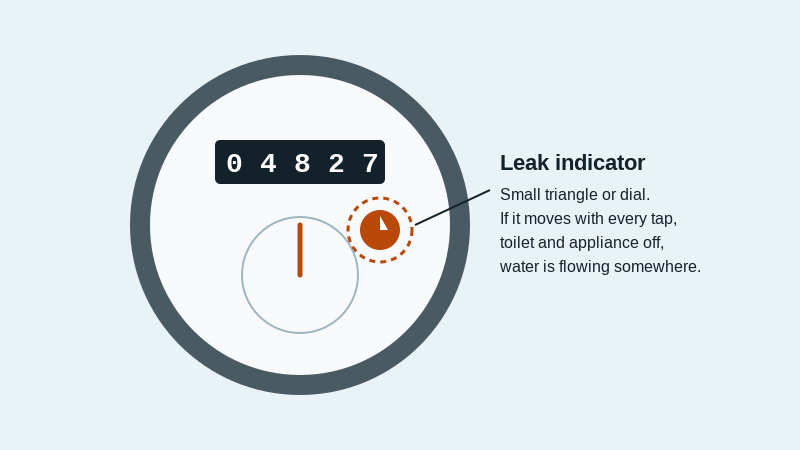
Look at the meter face. If the small leak indicator (often a red or black triangle, star or small dial) is turning, water is flowing past the meter right now. If it's perfectly still, move on to step 3 to catch slower leaks.
Step 3: Take a timed reading
Photograph the full meter reading, including the sweep hand. Wait at least 30 minutes, ideally an hour, without using any water. Photograph it again. Any change means water is leaving the system somewhere.
Step 4: Inside or outside?
Close the main shut-off valve at the house and watch the meter again.
| Result with house valve closed | What it suggests | Next step |
|---|---|---|
| Meter stops | The leak is inside the house | Check toilets, then see hidden leak detection |
| Meter keeps moving | The leak is on the line between the meter and the house, or the valve doesn't fully close | See water line leak detection |
Step 5: Rule out toilets
Toilets are the most common indoor leak. Add a few drops of food coloring to each tank. Wait 15 minutes without flushing. If color appears in the bowl, the flapper is leaking. A flapper is an inexpensive part and an easy fix for most people.
What the test can't tell you
A meter test tells you whether water is escaping and roughly which side of the house valve. It can't pinpoint where. If toilets and fixtures check out and the meter still moves, that's when professional leak detection helps.
Call your water utility. Leaks at the meter or on the street side are usually the utility's responsibility. See our service area page for which utility serves your address.
Think you have a hidden leak?
Call and describe the symptoms. You will get straight answers about what testing involves and what it may cost before anyone visits.